

Pulling Teeth Post Byline:
Blog post researched and written by Summer 2026 Historical Collections Intern, Tessa Mills. Tessa, a graduate student at the University of Kentucky School of Information Services, worked virtually to complete a 140-hour for-credit internship in UMB’s Historical Collections. She worked with the Dental Illustration Collection to help clean up metadata and add alternative text descriptions to the images.
Historical Context Note:
The Health Sciences and Human Services Library Historical Collections’ strives to provide broad access to our diverse collections both in person and digitally. Materials in our collections appear as they originally were published or created and may contain offensive or inappropriate language or images and may be offensive to users. The University of Maryland, Baltimore does not endorse the views expressed in these materials. Materials should be viewed in the context in which they were created.
Pulling Teeth: An Introduction
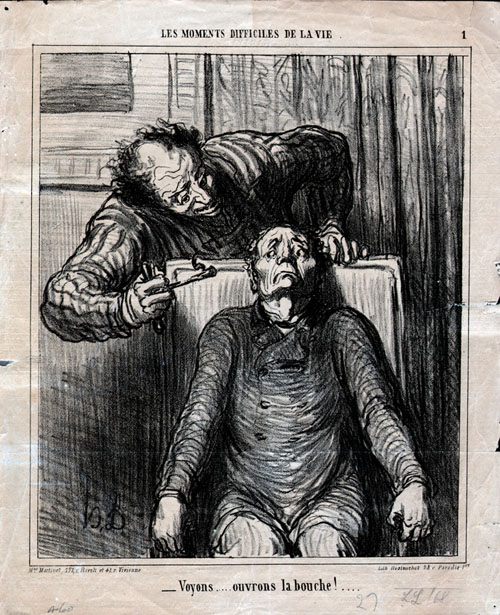
Long before modern anesthesia, advanced dental technology, or formal dental education, tooth extractions and other dental treatments were often painful affairs that inspired both anxiety and amusement. Historical artists captured these experiences through illustrations, caricatures, and satirical prints that reveal how dentistry was viewed by the public. Drawn from the UMB’s Dental Illustrations Collection in the Digital Archive, these images offer a glimpse into the history of dental care while highlighting the humor, fears, and cultural attitudes surrounding oral health.
The dental practitioners depicted in many of these illustrations often bore little resemblance to modern dentists. Prior to the professionalization of dentistry in the nineteenth century, few individuals performing dental procedures received formal education or standardized training. Tooth extraction was frequently carried out by itinerant tooth pullers who traveled from town to town, advertising their services in marketplaces and public squares. Others who offered dental treatment included barbers, blacksmiths, apothecaries, and self-proclaimed medical experts whose qualifications were often questionable. Many would have been labeled “quacks,” a term used to describe individuals who claimed medical expertise without the knowledge or credentials to support it. For many of these practitioners, tooth pulling was as much a public spectacle as it was a dental service, with crowds gathering to watch demonstrations of speed, strength, and showmanship. Turning the patient’s pain into a show itself.
Dentistry as Public Spectacle
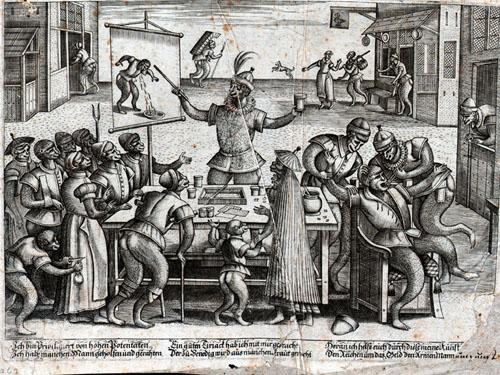 Before dentistry became a regulated profession practiced in private offices, tooth extraction was often a public event. Traveling practitioners and self-proclaimed specialists attracted customers by performing procedures in marketplaces, taverns, and other busy gathering places. Artists frequently portrayed these scenes as theatrical spectacles, emphasizing the crowds, dramatic gestures, and reactions of both patients and onlookers. These illustrations reveal how dental treatment occupied a unique space between healthcare, commerce, and entertainment.
In these depictions, dentistry is a less controlled healthcare practice and more a performance shaped by audience engagement. The presence of spectators is not incidental; it is central. Crowds gather not only out of curiosity, but because the procedure itself became a form of entertainment, framed by exaggerated gestures and heightened emotion. The practitioner’s role extends beyond treatment into showmanship, where credibility is performed as much as it is practiced. In this sense, the visual language of these works reflects a culture in which medical authority was still being negotiated in public view.
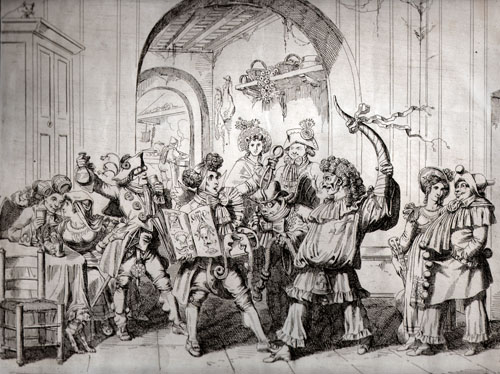 Rather than isolating the act of extraction, these illustrations situate it within social life. The boundary between observer and participant blurs, as the spectacle invites reaction, laughter, discomfort, fascination, or skepticism. Dentistry, in this context, exists within the same visual and cultured space as street performance and carnival tradition, where bodily vulnerability becomes part of a shared public experience.
The illustrations demonstrate that dentistry was often viewed as more than a medical service. Whether presented by traveling tooth-pullers, carnival performers, or satirical artists, dental procedures became public spectacles that attracted curiosity, laughter, and sometimes skepticism. The crowds depicted in these scenes remind us that dental treatment was once a highly visible part of public life. However, as artists continued to portray dentists and their patients, many shifted their attention from public performance to humor and exaggerations, creating caricatures and cartoons.
Caricature, Comedy, and the Theatrical Dentist
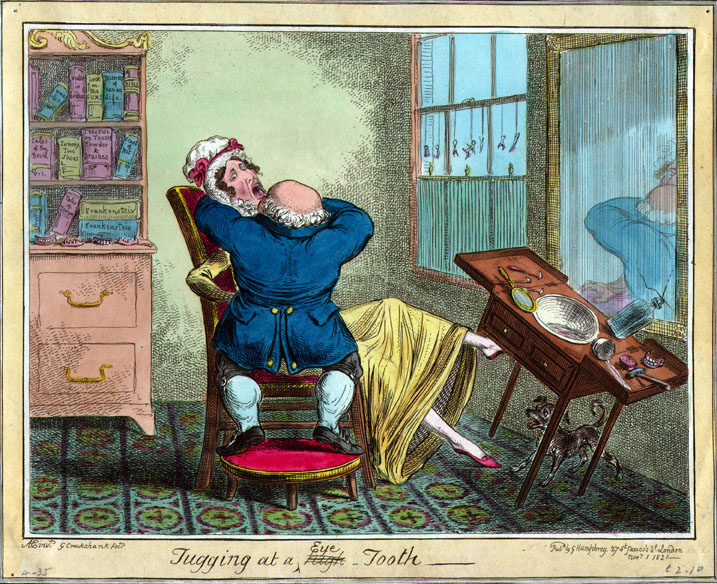 While early dental imagery often hovers between documentation and spectacle, caricature pushes things further, turning dental work into something overly performative. In these images, the dentist is rarely neutral. Instead, they become exaggerated figures of authority: looming, overly focused, and sometimes almost absurd in their intensity.
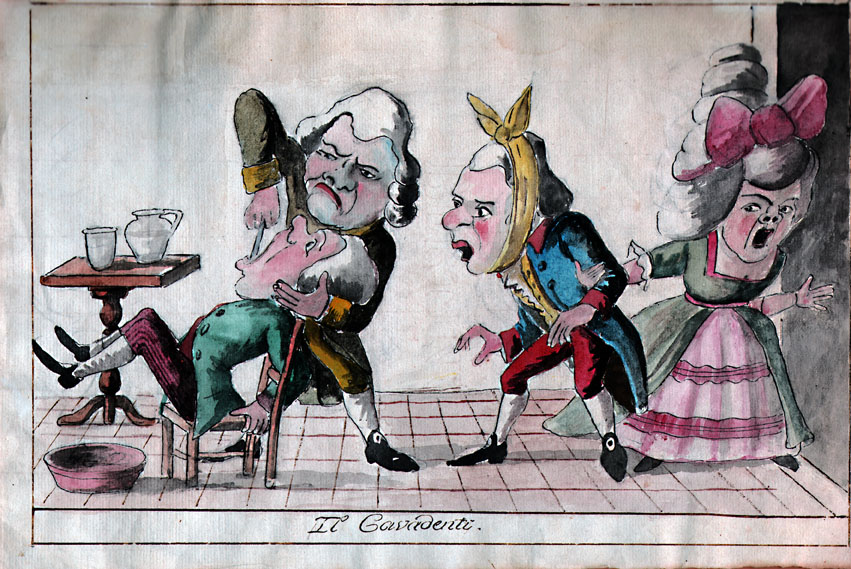 Patients in contrast, are frequently stripped of dignity in the name of humor. Open mouths, contorted bodies, and dramatic facial expressions transform routine procedures into visual punchlines. Pain is not hidden here, it is stylized. The result is a strange tension: suffering reframed as comedy.
What makes these illustrations especially interesting is how they borrow from theatrical traditions. The dental chair becomes a stage, and every gesture is amplified as if the scene were meant for an audience. Assistants hover like supporting actors, tools become props, and even the simplest extraction is treated like a climactic moment.
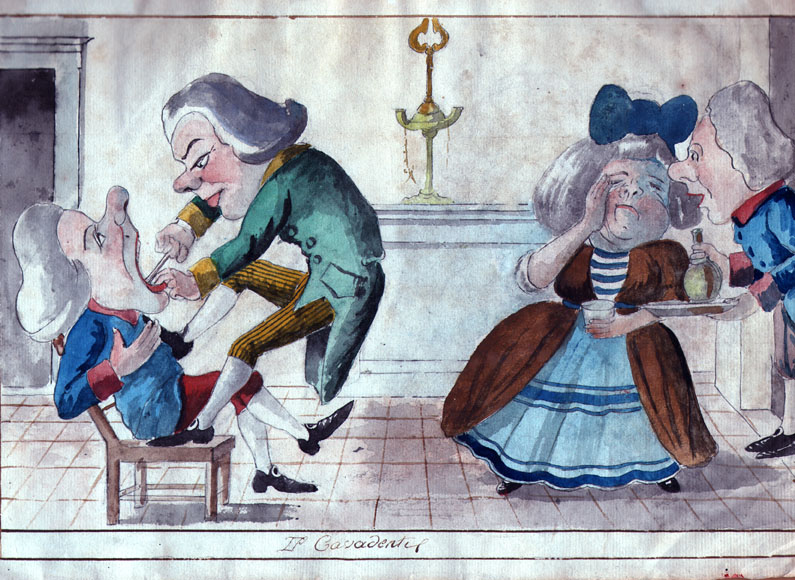 In many caricatures, dentistry is also tied to social commentary, reflecting broader anxieties about medical authority and trust. Meanwhile, patients are often exaggerated into recognizable “types,” reinforcing class-based humor and stereotypes that are common in satirical print culture.
Despite their humor, these images are doing more than making jokes. They expose how dentistry was perceived: invasive, theatrical, and deeply personal. The mouth becomes both a site of vulnerability and spectacle, and caricature thrives in that contradiction.
The Mechanics of Pain: Extractions Scenes and Dental Instruments

 If earlier illustrations lean into spectacle and satire, this section pulls us closer to the clinical sore of dentistry in pre-modern imagination: the act of extraction itself. Here, the dentist (barber-surgeon, or traveling “tooth-puller”) is no longer just a comedic figure or carnival performer, but someone engaged in a physically intimate and often brutal procedure.
Across these images, the focus shifts sharply to the moment of removal, the body held in place, the mouth open, and the tool taking center stage. In works like L’arracheur de dents 3 (Shown in this post), the extraction is not abstracted or softened, and the practitioner leans in with almost exaggerated concentration. The composition emphasizes force, leverage, and proximity, making the viewer acutely aware of the imbalance of control in the scene.
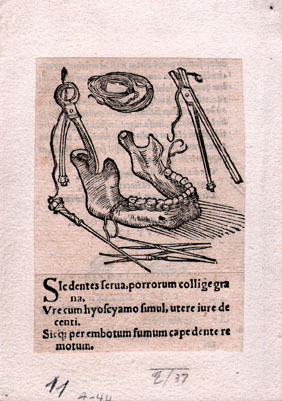
 The tools themselves become characters in their own right. Dental forceps, pelicans, and early extraction instruments are often rendered with careful attention, sometimes even more precisely than the human figures using them. This reflects both fascination and anxiety; these implements are extensions of authority, but also of violence. In many illustrations, they are oversized or sharply silhouetted, almost symbolic, as if to ensure the viewer understands their purpose even without medical context.
What’s especially striking is how often these scenes blur the line between documentation and drama. While they appear to depict real procedures, they are also composed for impact: the angle of the patient’s head, the dramatized strain in the dentist’s posture, and the surrounding onlookers reacting in horror or curiosity. The extraction becomes a kind of public event rather than a private medical act, reinforcing how dentistry was historically performed in semi-public spaces like fairs, streets, or taverns.
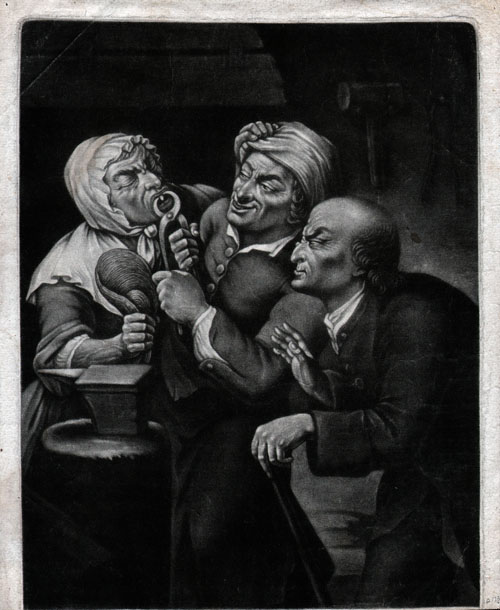 In this way, the illustrations don’t just record medical practice; they stage it. Pain is not hidden but made central, almost instructional; within these images pain is purpose. The viewer is invited to witness both the necessity and the spectacle of extraction, suspended between education and unease.
Between Medicine, Performance, and History
Looking across these dental illustrations, what emerges is not a single story about dentistry, but a layered one. These images move fluidly between humor and horror, spectacle and documentation, public entertainment and private suffering. A tooth extraction was never just a medical procedure; it became a performance, a social event, and at times, a form of satire aimed at both practitioner and patient.
What makes these works so compelling today is not just their historical value, but their emotional range. They capture a time when dentistry existed at the edges of medicine and theater, where pain was openly visible and often shared by an audience. Even the most exaggerated comedic scenes carry an undercurrent of vulnerability, reminding us that the mouth, so central to speech, expression, and identity, was also a site of fear and loss.
In revisiting these illustrations, we’re not just looking at the history of dental practice, we are also seeing how people once visualized pain, authority, and the body itself. And perhaps, that‘s why they still hold our attention; they sit in that uneasy space between fascination and discomfort, where art and medicine overlap most vividly.
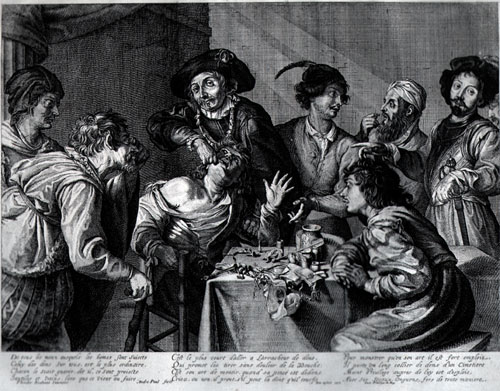
History, in this case, becomes a kind of visual record that paints a picture of how medicine once was, even when it feels distant or no longer relevant to modern practice. These images offer a glimpse into a world where medical knowledge, public performance, and cultural imagination were deeply intertwined, reminding us just how far dentistry and medicine have evolved over time.
The full Dentistry Illustrations Collection can be found in the University of Maryland Baltimore’s HSHSL Digital Archive. Questions about this collection can be directed to the Historical Collections Librarian, Tara Wink.