

The Health Sciences and Human Services Library Historical Collections’ strives to provide broad access to our diverse collections both in person and digitally. Materials in our collections appear as they originally were published or created and may contain offensive or inappropriate language or images and may be offensive to users. The University of Maryland, Baltimore does not endorse the views expressed in these materials. Materials should be viewed in the context in which they were created.
The inauguration of the 46th president of the United States occurs Wednesday, January 20, 2021. The United States and World will watch as Joseph R. Biden Jr. is sworn in as President along with Vice President Kamala Harris. In celebration of the United States Inaugural events, the Historical Collections Department of the Health Sciences and Human Services Library, is taking a moment to look back on our own Presidential history.
In 2020, the University of Maryland, Baltimore welcomed its own new President, Dr. Bruce Jarrell after nearly nine months as interim president following the departure of President, Dr. Jay Perman for the Chancellor’s Office in the University of Maryland System’s. Dr. Jarrell began his tenure as UMB President in a letter to the UMB community on his first official day, September 11, 2020.
In this letter, Dr. Jarrell mentions becoming the seventh president of UMB. While there have only been seven presidents in our more recent history; there have actually been 25 leaders of the University of Maryland, Baltimore. These leaders have had various roles and titles including, President, Provost, and Chancellor from its founding as the College of Medicine of Maryland in 1807 to today’s University. The following is a brief history of UMB and its leaders.
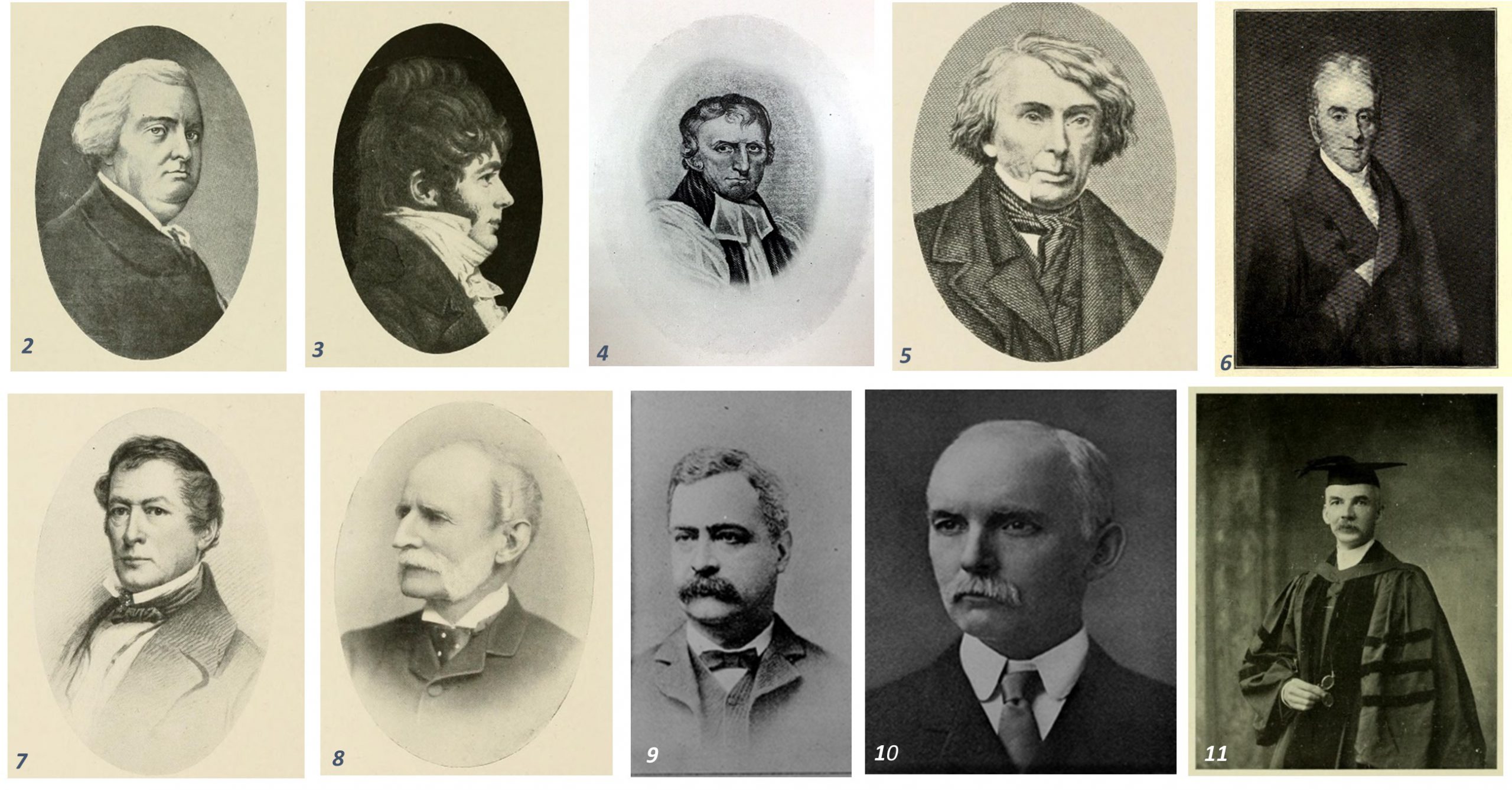
Early Campus History, Presidents and Provosts (1807-1920):
- George Brown, President College of Medicine of Maryland (1807-1812)
- Charles A. Warfield, President Board of Regents (1812-1813)
- Robert Smith, Provost (1813-1815)
- James Kemp, Provost (1815-1826)
- Roger B. Taney, Provost (1826-1839)
- Ashton Alexander, Provost (1837-1850)
- John Pendleton Kennedy, Provost (1850 -1870)
- Severn Teackle Wallis, Provost (1870-1890)
- Bernard Carter, Provost (1890-1912)
- Henry Stockbridge, Acting Provost (1912)
- Thomas Fell, Provost (1912-1920)
The University of Maryland, Baltimore traces its founding back to 1807 when the state of Maryland approved a law (Session 216, Chapter 53) opening the College of Medicine of Maryland. Soon after its founding Dr. George Brown was elected president of the College of Medicine of Maryland.
The College of Medicine of Maryland operated under that title until 1812, when a new law (Session 224, Chapter 159) created the University of Maryland. The new University was given the authority to organize a Faculty of medicine, arts and sciences, law, and divinity under the leadership of a Board of Regents. The Board of Regents approved a Provost as head of the campus which grew include five departments or schools (Medicine, Dentistry, Pharmacy, Law, and Liberal Arts, which was located at St. John’s College in Annapolis).
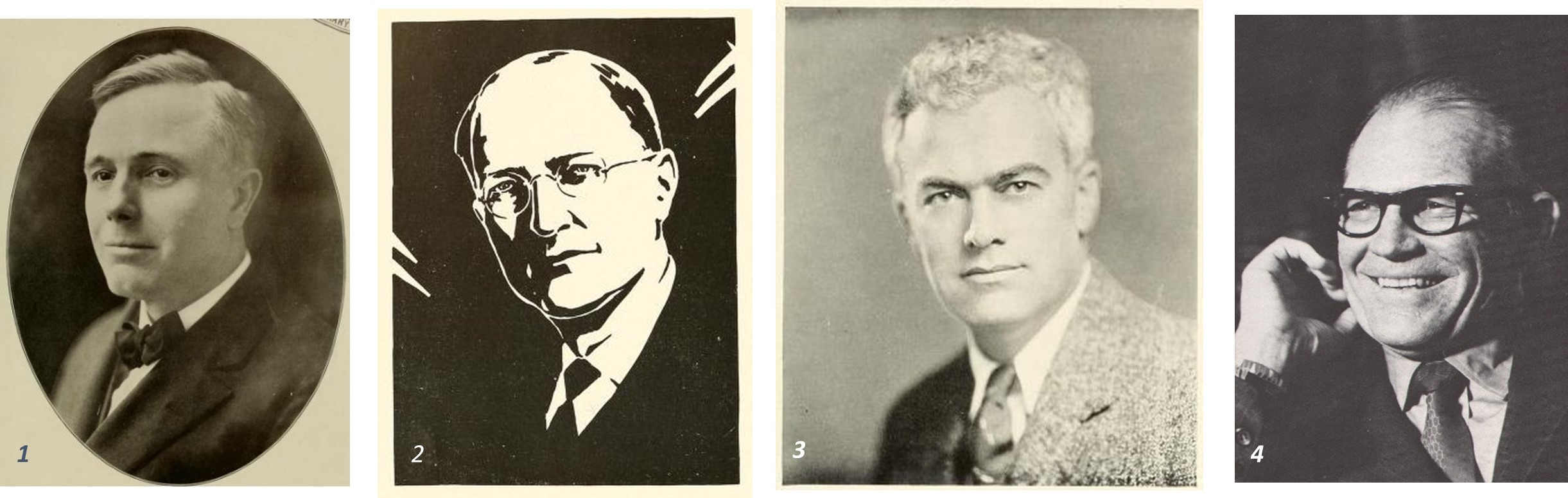
One University of Maryland, One President (1920-1965):
- Albert F. Woods (1920-1926)
- Raymond A. Pearson (1926 -1935)
- Harry C. Byrd (1935-1954)
- Wilson H. Elkins (1954-1965)
Following creation of the State System Elkins was named Chancellor and lead until 1978
In 1920, the State of Maryland once again passed a law (Session 310, Chapter 480) joining together the University of Maryland and the Maryland State Agricultural College (today’s University of Maryland, College Park). Under this law, the two schools operated as one state school with one president under the University of Maryland name. The college park campus was primarily used for undergraduate education, while the Baltimore campus operated the professional schools of Medicine, Dentistry, Pharmacy, Nursing, Law, and by 1961 Social Work.
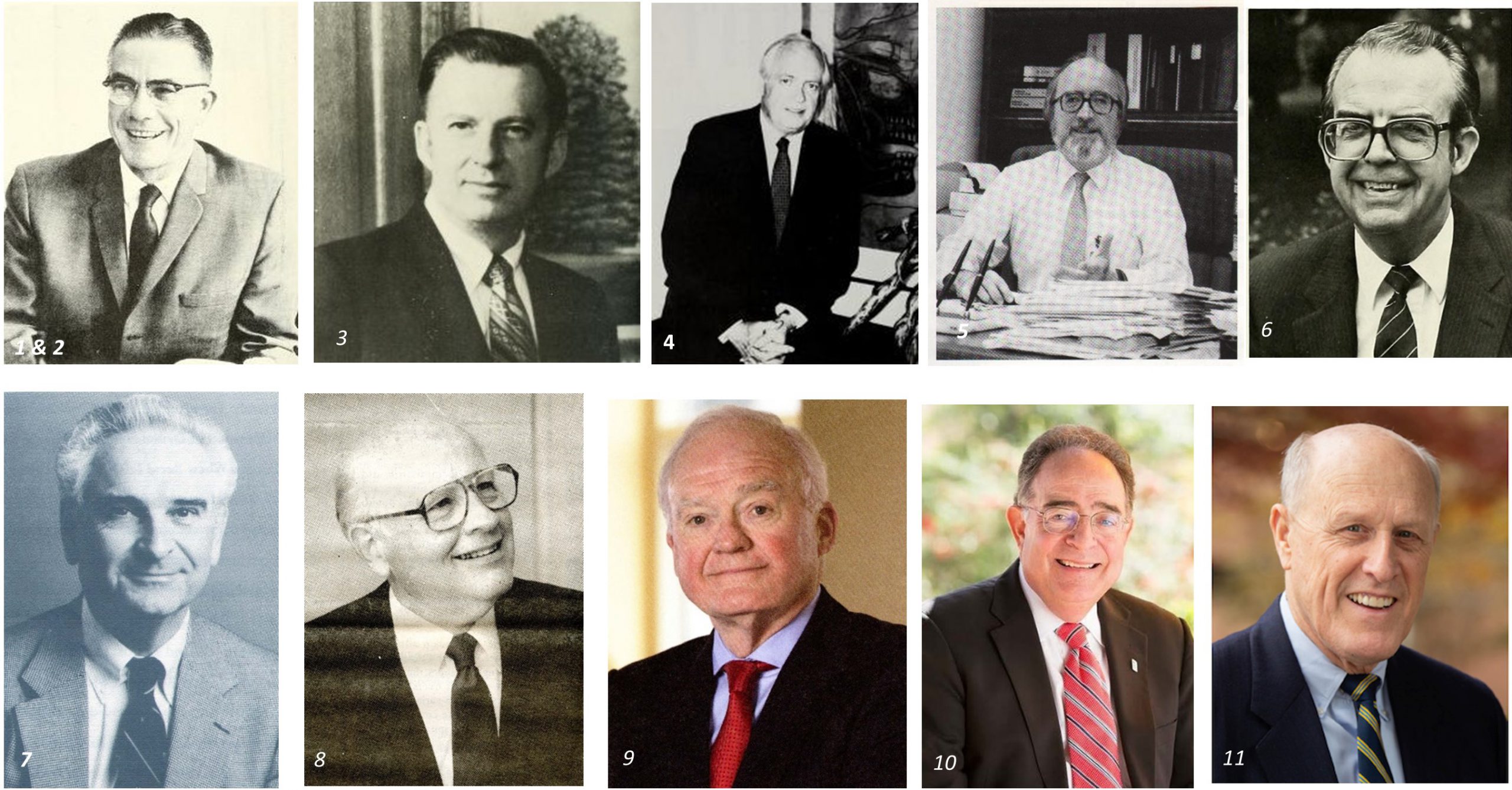
Creation of the University of Maryland State System, UMB Chancellors & Presidents (1965-Present):
- Albin O. Kuhn, Chancellor UMB & UMBC (1965-1971)
- Albin O. Kuhn, Full time Chancellor at UMB (1971-1980)
- Albert Farmer, Chancellor (1981-1984)
- John M. Dennis, Interim Chancellor (1984)
- Edward N. Brandt Jr., President (1984-1988)
- William J. Kinnard Jr., Acting President (1989-1990)
- Errol L. Reese, President (1990-1993)
- John W. Ryan, Interim President (1993-1994)
- David Ramsay, President (1994-2010)
- Jay Perman, President (2010-2020)
- Bruce Jarrell, President (2020 -Present)
In 1963, a state law (Session 358, Chapter 537) established the University of Maryland, Baltimore County (UMBC) branch, which opened in 1966. One chancellor, Dr. Albin O. Kuhn, oversaw both Baltimore campuses beginning in 1965. In 1970 the University of Maryland State System of five campuses was formed. The campuses included: University of Maryland at Baltimore; University of Maryland Baltimore County; University of Maryland, College Park; University of Maryland Eastern Shore; and University of Maryland University College. The five campuses, with the exception of Baltimore and Baltimore County, had their own chancellor. However, in 1971, the two Baltimore campuses (UMB and UMBC) hired their own chancellors, and Dr. Albin O. Kuhn became the first chancellor of UMB.
In 1988, the head of the individual campuses’ title was changed to president; thus, UMB’s first modern day president was Edward N. Brandt Jr. The term Chancellor was used for the individual overseeing the entire state system. Since that time, the University of Maryland, Baltimore, has had seven full-time and interim presidents at the helm. The presidents have faced a variety of challenges but have expanded the physical space of the campus as well as the national and international prestige.
References and further reading:
- Cordell, Eugene. (1903) The medical annals of Maryland, 1799-1899; prepared for the centennial of the Medical and Chirurgical Faculty.
- Cordell, Eugene. (1907) University of Maryland, 1807-1907, its history, influence, equipment and characteristics, with biographical sketches and portraits of its founders, benefactors, regents, faculty and alumni.
- University of Maryland, Baltimore Yearbooks.
- University of Maryland, Baltimore Newsletters, Magazines, and Reports.
- University of Maryland, School of Medicine Newsletters, Magazines, and Bulletins.
- University of Maryland, Office of the President Digital Archives.

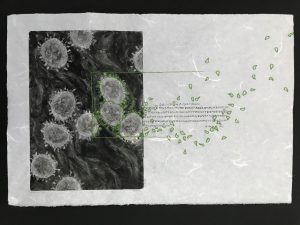 Since June, the Historical Collections Department of the Health Sciences and Human Services Library has been collecting campus reactions to the pandemic as well as personal stories and reflections of the campus community. The project,
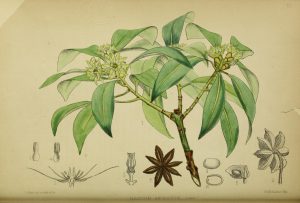 Illicium anisatum is a small tree that blossoms from January to April and is native to Japan. The tree was cultivated in China and introduced in England in 1842. The fruit, called “star-anise,” has eight or nine points forming a star shape. The fruit is dried to sell and has a pleasant aromatic odor; the taste is a mixture of fennel and anise or black licorice. An oil, called oil of anise or oleum badiani, is produced from the tree.
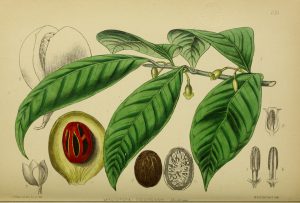 Myristica fragrans is a small evergreen tree that produces fruit the size of a small pear. The seed of the fruit is known as “nutmeg.” The tree was native to Moluccas (Maluku Islands) and Indian Islands, Amboyna Island, Bouro (Portugal), New Guinea, the Philippines, Bencoolen (British East India Company), Penang Island, Singapore, Mauirtius, West Indies, and South America. The tree was introduced to Europe in 1795. The fruit harvest occurred from September to December as well as April to June.
 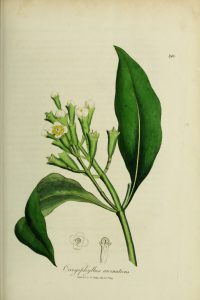 Caryophyllus aromaticus is a small tree native of the East Indies, Moluccas (Maluku Islands), and New Guinea. According to Woodville, Dutch traders were rumored to have clove trees outside of their jurisdiction destroyed to hold a monopoly on the clove trade. This confined the trees to the Island of Ternate controlled by the Dutch. The Dutch monopoly ended in 1770 when clove and nutmeg trees were brought to the Isle of France, Bourbon, and Seickelles.
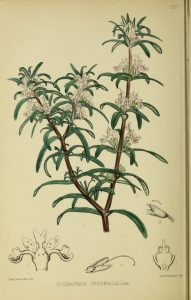 Rosmarinus officinalis is a small shrub native to the Mediterranean. The shrub was also commonly found near the coast in warm, dry, hilly areas in Spain and Asia Minor and in Northern Africa, reaching to Madeira and the Canary Islands. It flowers in April and May. Rosemary is aromatic and has a warm, bitter taste. The flavor and scent are strongest when the plant is fresh; both are impaired when the plant is dried.
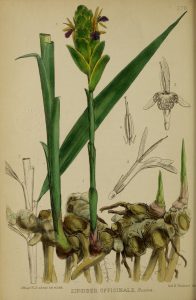 Zingiber officinale is a perennial herb. Ginger has a large underground stem, known as a rhizome. It is tough, pale yellow, covered with pale silvery-brown skin, with persistent roundish joints and numerous roots. Ginger is native to tropical Asia and abundant in the West Indies. It was exported to Europe sometime in the seventeenth century.
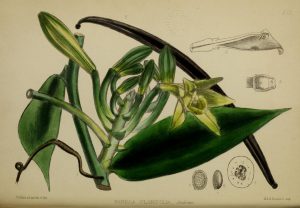 Vanilla planifolia is a succulent. It is a dark green perennial climber that grows from five to six inches long. The plant flowers in April and May and is related to orchids. Vanilla is native to southeast Mexico, Vera Cruz, Mauritius, Bourbon, Madagascar, and Java. It was introduced to England sometime around 1800. The plant produces pods, which were traditionally collected before they were fully ripe, dried in the shade, and then covered in a coating of oil.
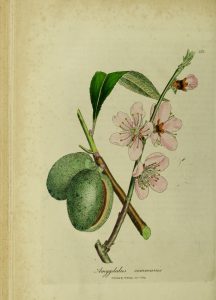 Common name: Almond Tree
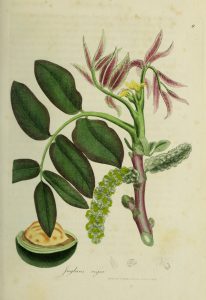 Juglans regia is a large tree that flowers in April and May. The fruit of the tree ripens at the end of September. The walnut tree is native to Persia but was cultivated in England during Woodville’s time.
 The Health Sciences and Human Services Library Historical Collections’ strives to provide broad access to our diverse collections both in person and digitally. Materials in our collections appear as they originally were published or created and may contain offensive or inappropriate language or images and may be offensive to users. The University of Maryland, Baltimore does not endorse the views expressed in these materials. Materials should be viewed in the context in which they were created.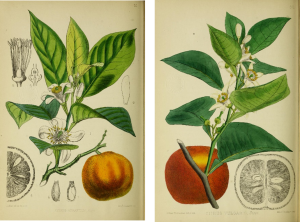
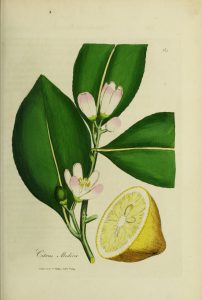 Citrus Medica
 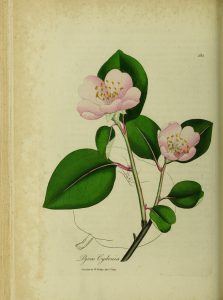 Pyrus Cydonia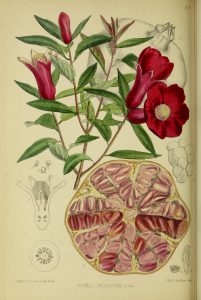
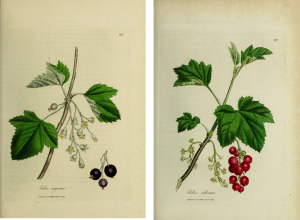 Ribes Rubrum & Ribes Nigrum